
Background
The Central Government, in exercise of the powers conferred by section 133 read with section 469 of the Companies Act, 2013 and in consultation with the National Financial Reporting Authority, has notified the Companies (Indian Accounting Standards) Amendment Rules, 2026 vide notification G.S.R. 725(E) dated 12 August 2026. The rules further amend the Companies (Indian Accounting Standards) Rules, 2015 and modify Ind AS 101, Ind AS 107, Ind AS 109, Ind AS 110 and Ind AS 7.
The amendments are effective for annual reporting periods beginning on or after 1 April 2026. Appendix 1 to Ind AS 109 has been substituted to record that paragraph 7.1.13 of IFRS 9 has not been included in Ind AS 109 since it relates to early application of the amendments to the classification and measurement of financial instruments, ‘which is not permitted in India’. Entities forming part of groups that report under IFRS Accounting Standards may therefore apply different bases in their group reporting and in their statutory financial statements until the amendments become effective.
While certain amendments are clarificatory, those relating to financial instruments with contingent contractual features, to contracts referencing nature-dependent electricity and to the derecognition of financial liabilities settled through electronic payment systems are expected to have a direct effect on classification, measurement, hedge accounting and disclosure.
1. Standards amended and effective date
The notification amends five standards through paragraph-level changes drawn from three sets of amendments: Amendments to the Classification and Measurement of Financial Instruments, Contracts Referencing Nature-dependent Electricity, and Annual Improvements to Ind AS (2024). The standards affected are set out below.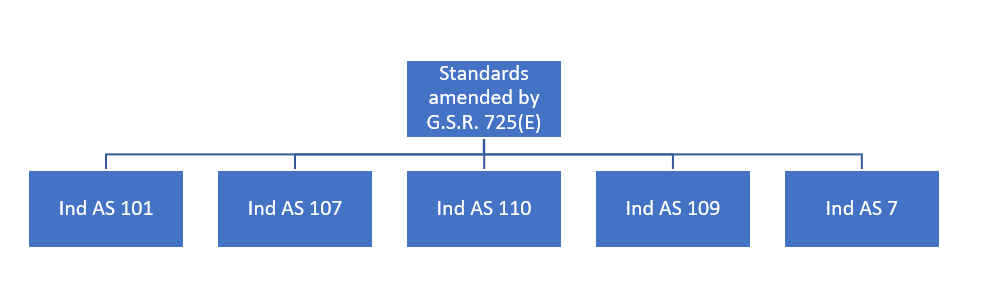
Each of these standards is addressed in the sections that follow, in the order set out in the Areas of Coverage above.
2. Contingent contractual features and the SPPI assessment
Newly inserted paragraph B4.1.10A of Ind AS 109 addresses a financial asset containing a contingent feature where the nature of the contingent event does not relate directly to changes in basic lending risks and costs, such as an interest rate adjustment linked to the achievement of a contractually specified reduction in carbon emissions. Such an asset has contractual cash flows that are solely payments of principal and interest if, and only if, in all contractually possible scenarios those cash flows would not be significantly different from the contractual cash flows on an instrument with identical terms but without the contingent feature.
Amended paragraph B4.1.10 requires the contractual cash flows arising both before and after the change to be assessed ‘irrespective of the probability of the change in contractual cash flows occurring’. The likelihood of the contingent event is therefore not relevant to the assessment.
Newly inserted paragraph B4.1.8A provides that contractual cash flows are inconsistent with a basic lending arrangement where they are indexed to a variable that is not a basic lending risk or cost, such as the value of an equity instrument or the price of a commodity, or where they represent a share of the debtor’s revenue or profit, even if such contractual terms are common in the market in which the entity operates. The notification illustrates the distinction: a loan whose rate is adjusted by a fixed number of basis points on achievement of an emissions target satisfies the criterion, whereas a loan whose rate tracks a market-determined carbon price index does not.
Paragraphs B4.1.16A, B4.1.17, B4.1.20, B4.1.20A, B4.1.21 and B4.1.23 have been revised in relation to financial assets with non-recourse features and to contractually linked instruments. Paragraph B4.1.16A provides that a financial asset has non-recourse features where the entity’s ultimate right to receive cash flows is contractually limited to the cash flows generated by specified assets, and paragraph B4.1.17 requires the entity to consider how that link is affected by other contractual arrangements, such as subordinated debt or equity instruments issued by the debtor.
3. Contracts referencing nature-dependent electricity
Newly inserted paragraph 2.3A of Ind AS 109 defines contracts referencing nature-dependent electricity as contracts that expose an entity to variability in the underlying amount of electricity because the source of electricity generation depends on uncontrollable natural conditions. Both contracts to buy or sell such electricity and financial instruments referencing it are included. Paragraph 2.3B prohibits application of the related guidance by analogy to other contracts, items or transactions.
Paragraph B2.7 recognises that an entity may have no practical ability to avoid making sales of unused electricity where the design and operation of the electricity market require unused amounts to be sold within a specified time, and provides that such sales are not necessarily inconsistent with the contract being held in accordance with the entity’s expected usage requirements. The contract is regarded as held for expected usage requirements where the entity has been, and expects to be, a net purchaser of electricity for the contract period. An entity is a net purchaser where it buys sufficient electricity to offset the sales of any unused electricity ‘in the same market in which it sold the electricity’.
Paragraph B2.8 requires the assessment to be made using reasonable and supportable information available without undue cost or effort about past, current and expected future electricity transactions over a reasonable amount of time, identified by reference to the seasonal cycle of the natural conditions and the entity’s operating cycle. In determining whether the entity has been a net purchaser, a reasonable amount of time shall not exceed twelve months.
Entities with open access, group captive or virtual power purchase arrangements should maintain generation, consumption and settlement records analysed by the market in which each transaction was executed, since the assessment is a continuing one and a reduction in consumption may affect the conclusion in subsequent periods.
4. Hedge accounting for nature-dependent electricity contracts
Newly inserted paragraph 6.10.1 permits an entity that designates a contract referencing nature-dependent electricity as a hedging instrument in a hedge of forecast electricity transactions to designate as the hedged item a variable nominal amount of forecast electricity transactions, aligned with the variable amount of electricity expected to be delivered by the generation facility referenced in the hedging instrument. Paragraph 6.10.2 provides that where the cash flows of the hedging instrument are conditional on the occurrence of that forecast transaction, the forecast transaction is presumed to be highly probable for the purposes of paragraph 6.3.3. All other hedge accounting requirements continue to apply.
Paragraph 7.2.53 requires paragraphs 6.10.1 and 6.10.2 to be applied prospectively to hedging relationships designated on or after the date of initial application. At that date an entity is permitted to discontinue a hedging relationship in which such a contract has been designated as the hedging instrument, provided the same hedging instrument is designated in a new hedging relationship in accordance with those paragraphs. Entities carrying existing designations based on a fixed volume should consider whether to avail this option at the date of initial application.
5. Derecognition of financial liabilities settled electronically
Newly inserted paragraph B3.1.2A confirms that, unless an entity elects to apply paragraph B3.3.8, a financial liability is derecognised on the settlement date. Paragraph B3.3.8 permits an entity, when settling a financial liability in cash using an electronic payment system, to deem the liability to be discharged before the settlement date if, and only if, it has initiated a payment instruction that resulted in the entity having no practical ability to withdraw, stop or cancel the instruction, the entity having no practical ability to access the cash to be used for settlement, and the settlement risk associated with the electronic payment system being insignificant.
Paragraph B3.3.9 provides that settlement risk would not be insignificant where completion of the payment instruction is subject to the entity’s ability to deliver cash on the settlement date. Paragraph B3.3.10 requires an entity that elects to apply paragraph B3.3.8 to apply it to all settlements made through the same electronic payment system.
The election is an accounting policy choice and is not mandatory. As it affects the reported balances of cash and cash equivalents, trade payables and borrowings at the reporting date, and consequently liquidity and leverage ratios and any covenants computed on them, the position adopted should be documented and applied consistently.
6. Disclosure requirements introduced by Ind AS 107
Newly inserted paragraphs 20B to 20D require an entity to disclose, by class of financial assets measured at amortised cost or at fair value through other comprehensive income and by class of financial liabilities measured at amortised cost, a qualitative description of the nature of contingent events that could change contractual cash flows, quantitative information about the possible changes to those cash flows, and the gross carrying amount of financial assets and the amortised cost of financial liabilities subject to such terms.
Newly inserted paragraphs 30A to 30C require information about contracts referencing nature-dependent electricity to be disclosed in a single note, covering contractual features giving rise to exposure, unrecognised commitments including estimated future cash flows in appropriate time bands and the assessment of whether a contract may become onerous, and the effects on financial performance for the reporting period.
Paragraph 11A has been amended to require the disclosures for investments in equity instruments designated at fair value through other comprehensive income to be given for each class of investment, and new items 11A(f) and 11B(d) require the fair value gain or loss recognised in other comprehensive income and the transfers of cumulative gain or loss within equity to be presented separately for investments derecognised during the reporting period and investments held at the end of the reporting period.
7. Other amendments and transition
Paragraph 2.1(b)(ii) of Ind AS 109 has been amended so that lease liabilities recognised by a lessee are subject to the derecognition requirements in paragraphs 3.3.1 and 3.3.3, with the effect that any difference arising on extinguishment of a lease liability is recognised in profit or loss. Paragraph 5.1.3 requires trade receivables without a significant financing component to be measured at the amount determined by applying Ind AS 115. Paragraphs B5 and B6 of Ind AS 101 have been substituted in relation to hedging relationships existing at the date of transition. Paragraph B74 of Ind AS 110 has been substituted in relation to the identification of de facto agents, and Appendix C has been replaced by an appendix on effective date and transition, with the previous cross-reference content carried into a new Appendix D. Paragraph 37 of Ind AS 7 has been amended to refer to investments accounted for at cost.
Paragraph 7.2.47 requires retrospective application in accordance with Ind AS 8. Under paragraph 7.2.48 prior periods need not be restated, and where they are not, the cumulative effect is recognised as an adjustment to the opening balance of retained earnings at the date of initial application. Paragraph 7.2.49 requires disclosure, for each class of financial assets that changed measurement category, of the measurement category and carrying amount determined immediately before and immediately after the amendments were applied. The amendment to paragraph 2.1(b)(ii) applies to lease liabilities extinguished on or after the beginning of the annual reporting period in which it is first applied.
For detailed information on this aspect, please refer :
- Companies (Indian Accounting Standards) Amendment Rules, 2026, G.S.R. 725(E) dated 12 August 2026 : Ministry of Corporate Affairs https://www.mca.gov.in/
- Companies (Indian Accounting Standards) Rules, 2015, G.S.R. 111(E) dated 16 February 2015 : Ministry of Corporate Affairs
Disclaimer
The information contained herein is in summary form based on Companies (Indian Accounting Standards) Amendment Rules, 2026 notified vide notification G.S.R. 725(E) dated 12 August 2026. While the information is believed to be accurate to the best of our knowledge, we do not make any representations or warranties, express or implied, as to the accuracy or completeness of this information. Recipients should conduct and rely upon their own examination and analysis and are advised to seek their own professional advice. This note is not an offer, invitation, advice or solicitation of any kind. We accept no responsibility for any errors it may contain, whether caused by negligence or otherwise or for any loss, howsoever caused or sustained, by the person who relies upon it.